
A Comprehensive Cultural Exploration

Welcome back, class, to today’s in-depth study! Our subject matter is the Mid-Autumn Festival, a significant cultural observance, and its most iconic culinary symbol, the mooncake. Celebrated primarily across East Asia, this festival offers a rich tapestry of history, mythology, and tradition. This exploration will meticulously detail the historical roots, profound cultural significance, and the diverse characteristics of mooncakes, providing a comprehensive understanding of this cherished annual event.
Chapter 1: Historical and Mythological Foundations – Tracing Ancient Origins
The Mid-Autumn Festival possesses deep roots in ancient Chinese traditions and a captivating mythology. At its core, the festival is intricately linked to the legend of Chang’e, the mythical Moon Goddess of Immortality. This narrative, often recounted during family gatherings, tells of Chang’e’s ascent to the moon, becoming its eternal resident. Her story serves as a poignant reminder of longing, separation, and the enduring human connection to the celestial sphere. It highlights themes of sacrifice and the pursuit of immortality, which resonate deeply within Chinese culture.
Historically, the festival’s origins can be traced back thousands of years, evolving from ancient harvest celebrations. Evidence suggests that the practice of honoring the moon during autumn dates back to the Shang Dynasty (c. 1600–1046 BC). The Liji (Book of Rites), an ancient Chinese classical text that meticulously records customs and ceremonies from the Zhou Dynasty (c. 1046–256 BC), indicates that Chinese Emperors traditionally offered sacrifices to the Sun in spring and to the Moon in autumn. This practice underscores the festival’s ancient lineage and its fundamental connection to agricultural cycles and astronomical observations. These rituals were essential for ensuring bountiful harvests and maintaining cosmic harmony, reflecting a deep respect for the natural world. The specific date for the autumnal observation became formalized: the 15th day of the 8th lunar month was designated as “Mid-Autumn,” signifying its position in the middle of the autumn harvest season, coinciding with the fullest and brightest moon. The evening of this day is reverently known as the “Night of the Moon,” emphasizing its primary focus on moon appreciation and contemplation. This historical context provides a solid foundation for understanding the festival’s enduring importance and its evolution over millennia.
Chapter 2: The Enduring Popularity and Symbolism of Mooncakes
Mooncakes are undeniably central to the Mid-Autumn Festival. Their pervasive presence and profound cultural significance have led to the festival being commonly referred to as the “Mooncake Festival” in many regions, highlighting their iconic status. These pastries transcend mere confectionary; they function as potent symbolic representations of reunion, completeness, and the full, luminous moon itself. Their perfectly round or square shape is a direct metaphor for familial unity and the cyclical nature of life, making them an indispensable element of the celebration.
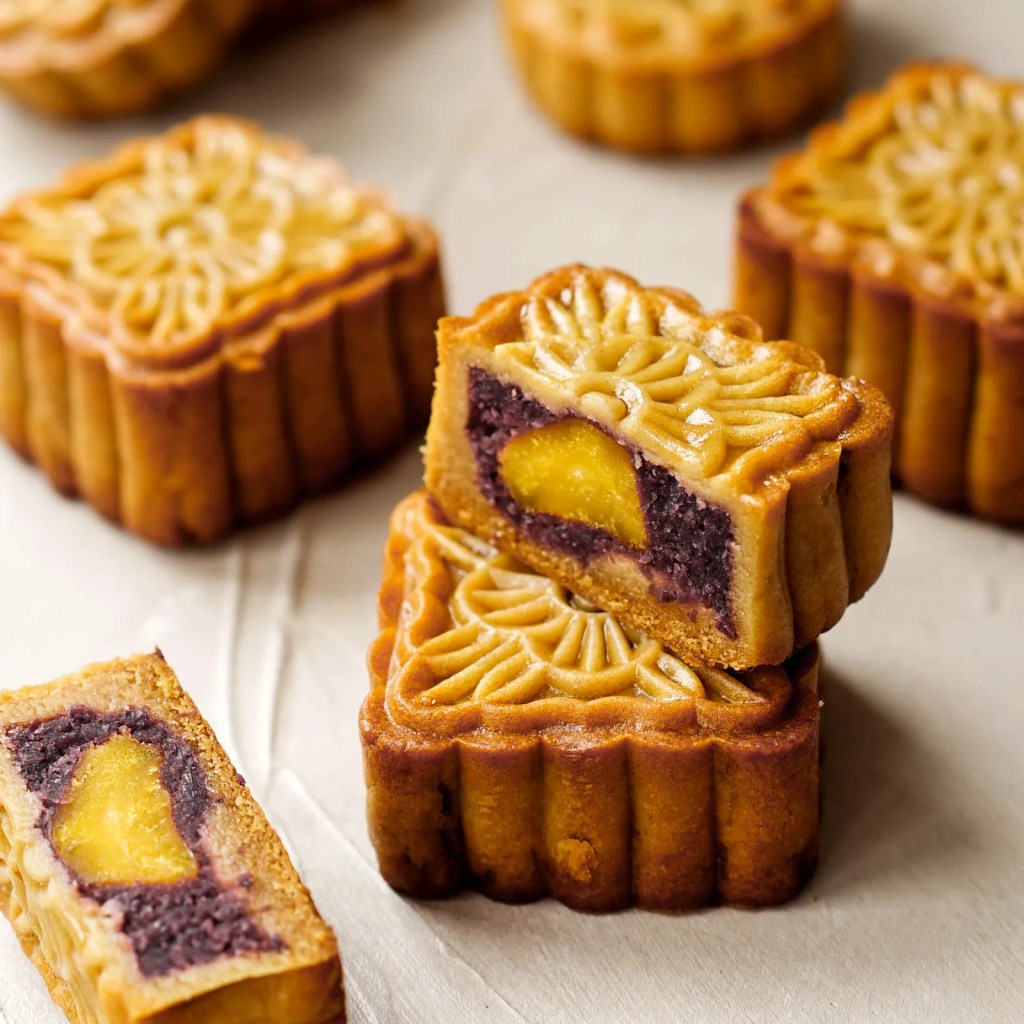
From a structural perspective, most mooncakes are composed of a thick, tender pastry skin that exquisitely encases a sweet, dense filling. A hallmark of traditional mooncakes is the inclusion of one or several whole salted duck egg yolks positioned precisely in the center. These yolks not only provide a unique savory contrast to the sweet filling, creating a balanced flavor profile, but also visually symbolize the full moon, reinforcing the festival’s lunar theme and the idea of completeness. The preparation methods for mooncakes vary by regional custom and culinary tradition; they can be meticulously steamed, carefully baked to a golden brown, or expertly fried, with each technique imparting a distinct texture and flavor profile to the final product. This diversity in preparation adds to the richness of the mooncake tradition.
The aesthetic appeal of traditional mooncakes is further enhanced by intricate imprints on their top surface. These imprints are not merely decorative; they typically feature auspicious Chinese characters, such as “longevity” (寿) or “harmony” (和), conveying blessings and good wishes to those who consume them. Additionally, the name of the bakery and the specific type of filling are often clearly included, providing both branding and practical information. Beyond textual elements, decorative motifs frequently surround these characters, including detailed depictions of the Moon itself, the graceful figure of Chang’e, delicate floral patterns, winding vines, or the endearing image of a rabbit, which is a traditional symbol strongly associated with the Moon (often representing the Jade Rabbit, a companion to Chang’e who is said to pound the elixir of immortality). Each element of the mooncake, from its shape to its imprints and fillings, is deeply imbued with cultural meaning and historical significance.
Chapter 3: A Revolutionary Role: Mooncakes in Dynastic History
Beyond their celebratory function, mooncakes hold a remarkable and unique place in Chinese political history, having played a strategic role in a pivotal dynastic upheaval. Historical accounts suggest that mooncakes were ingeniously utilized by revolutionaries in their efforts to overthrow the Mongol-led Yuan dynasty during the 14th century, a movement that ultimately culminated in the establishment of the native Chinese Ming dynasty. This narrative serves as a powerful example of how everyday objects can become instruments of significant historical change.
The tactical brilliance behind this use is widely attributed to Zhu Yuanzhang, who would later become the first emperor of the Ming dynasty, and his astute advisor Liu Bowen. Their ingenious strategy involved circulating a widespread rumor that a deadly plague was afflicting the populace and that the only effective preventative measure was the consumption of special mooncakes, which were purported to possess instantaneous revival and empowering properties. This fabricated narrative facilitated the rapid and unquestioned distribution of these pastries throughout the populace, including among the unsuspecting Mongol ruling class. Crucially, within these seemingly innocuous mooncakes, a secret message was concealed. This message contained a precise instruction: “On the fifteenth day of the eighth lunar month, kill the rulers.” This coordinated message, delivered through a seemingly innocent medium, was key to synchronizing the rebellion.
An alternative, equally clever method for message concealment involved printing the secret message on the surfaces of mooncakes, which were typically sold in packages of four. The message was designed as a simple puzzle or mosaic. To decipher it, each of the four mooncakes had to be cut into four equal parts. The resulting sixteen pieces, when correctly reassembled, would reveal the complete revolutionary directive. Following the successful decryption of the message, the mooncake pieces were promptly consumed, thereby destroying the evidence and ensuring the secrecy of the plot. This historical episode serves as a compelling testament to the mooncake’s versatility, demonstrating its capacity to function not only as a festive food but also as a clandestine instrument of communication and revolution, highlighting the ingenuity of those striving for freedom.
Chapter 4: Diversity in Fillings and Contemporary Adaptations
The array of mooncake fillings is remarkably diverse, catering to a broad spectrum of palates and regional preferences, a testament to culinary innovation within tradition. Traditional fillings, often considered classics, include:
- Lotus Seed Paste: Often regarded as the original and most luxurious filling, this smooth, sweet paste is derived from lotus seeds and remains a staple in high-quality traditional mooncakes, prized for its delicate flavor and creamy texture.
- Sweet Bean Paste: A common and versatile filling found in numerous Chinese desserts. While red bean paste (from azuki beans) is globally the most prevalent, regional preferences also favor pastes made from mung beans and black beans, each offering a distinct flavor profile and level of sweetness.
- Jujube Paste: A rich, sweet paste crafted from the ripe fruits of the jujube (Chinese date) plant, providing a unique fruity sweetness and a slightly chewy texture.
- Five Kernels or Mixed Nuts (五仁): This traditional filling consists of a coarse mixture of five types of nuts and seeds (e.g., walnuts, almonds, sesame seeds, pumpkin seeds, melon seeds), typically bound together with maltose syrup. It offers a satisfying textural contrast and a complex nutty, earthy flavor, often considered a more savory option among traditional sweet fillings.
In contemporary times, mooncake fillings have undergone significant diversification, embracing virtually any ingredient that can be processed into a paste, reflecting evolving tastes and global culinary influences. Fillings such as taro paste and pineapple, which were once considered novelty items upon their invention, have now become commonplace due to their popularity. Modern variations further expand the palate, incorporating ingredients like coffee, chocolate, various nuts (e.g., walnuts, pecans, pistachios), an assortment of fruits (e.g., prunes, pineapples, melons, lychees, durian), vegetables (e.g., sweet potatoes, purple yam), and even savory components such as ham or abalone, introducing a modern twist to the traditional recipes and appealing to a broader, more adventurous demographic.
The Mid-Autumn Festival is widely recognized as one of the four most important Chinese festivals, alongside the Lunar New Year, Dragon Boat Festival, and Qingming Festival. It is fundamentally a time for family reunion, thanksgiving for the harvest, and communal celebration, with the ritualistic sharing of mooncakes among friends and family remaining a central and cherished custom. This practice reinforces familial and social bonds, expresses good wishes, and fosters a sense of collective identity under the benevolent glow of the autumn moon.
 Black Frog Communications